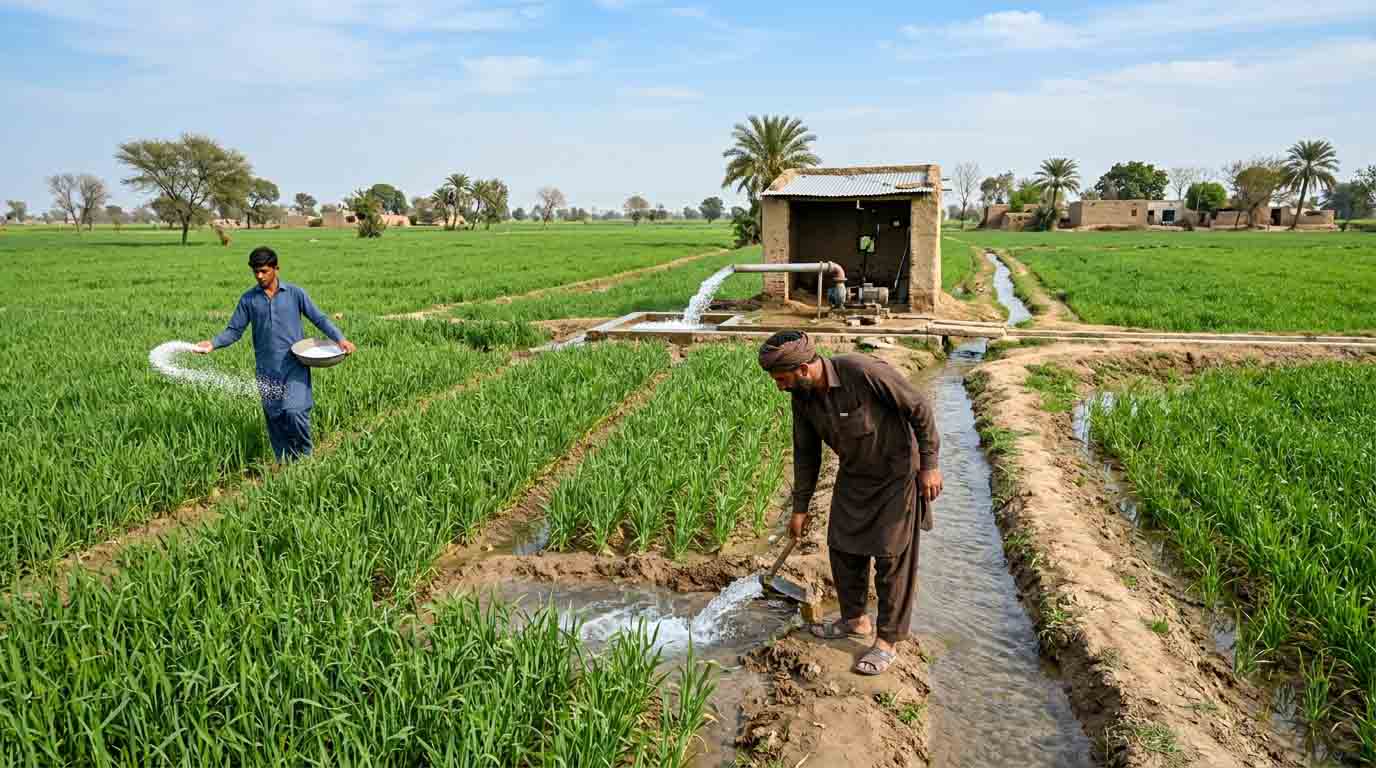
Guide to Water and Fertilizer Water and fertilizer are the two biggest “inputs” in Pakistani farming. If you manage them well, you can increase yield, reduce cost, and protect your soil for future crops. In 2026, farming conditions in Pakistan are changing fast due to heat waves, irregular rain, rising input prices, and groundwater salinity. That is why farmers need a clear and practical plan for water management and fertilizer management.
This guide is written in simple English for Pakistan farmers. It covers canal and tube-well irrigation, soil testing, and step-by-step fertilizer use with common fertilizers like Urea, DAP, and NPK.
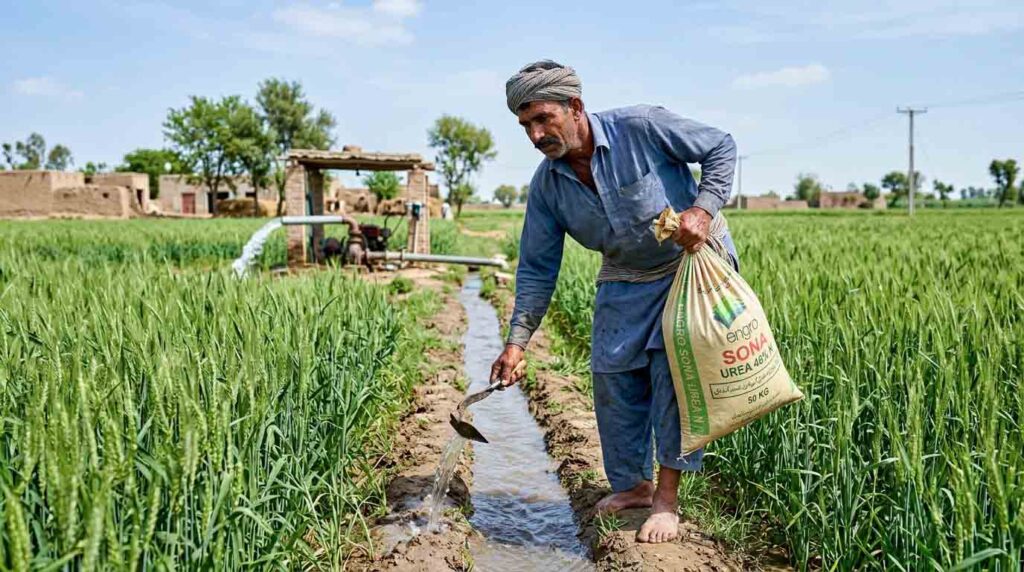
Why Water and Fertilizer Management Matters in Pakistan (2026)
Pakistan’s major farming areas (Punjab, Sindh, KP, Balochistan) face common issues:
- Water shortage in canals and uncertain schedules
- Tube-well water is expensive (diesel/electricity)
- Salinity and sodicity in many areas (especially lower Punjab and Sindh)
- High temperature and fast evaporation in summer crops (cotton, rice, sugarcane, vegetables)
- Fertilizer losses due to wrong timing, wrong dose, or improper irrigation
Good management helps you:
- Save water (10–30% in many cases)
- Reduce fertilizer waste (especially nitrogen loss)
- Improve crop health and grain quality
- Protect soil fertility and reduce salinity problems
Soil Testing in Pakistan (First Step Before Fertilizer)
Before applying fertilizers, know what your soil already has. Soil testing helps you avoid “blind fertilization” (guessing).
Best time to take soil sample
- Before sowing (ideal)
- Or after harvest for planning next season
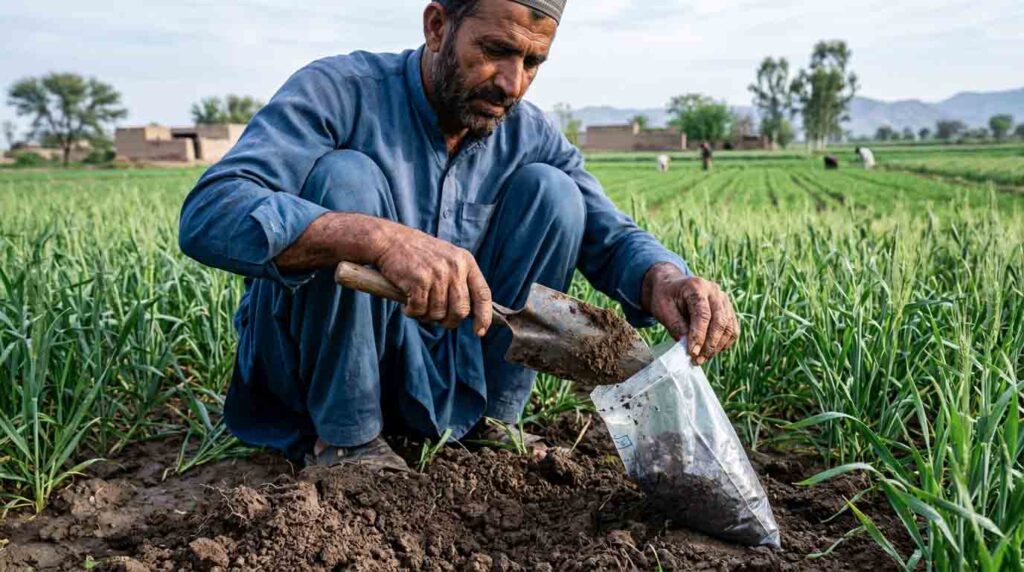
Simple soil sampling method (farmer-friendly)
- Select a field area (same crop history, same soil type).
- Remove surface trash.
- Take soil from 6–8 inches depth (for most crops).
- Collect 10–15 small samples from different spots.
- Mix well, make one final sample (about ½ kg).
- Send to nearest government lab / private soil lab.
Table: Soil Testing Methods in Pakistan (Steps + Benefits)
| Soil Testing Method | Where It Is Used | Simple Steps | Main Benefit for Farmers |
|---|---|---|---|
| Lab Soil Test (NPK, OM, pH, EC) | Most accurate (Punjab/Sindh/KP/Balochistan labs) | Take sample → label → send to lab → follow report | Correct fertilizer dose, saves money, improves yield |
| Rapid Soil Test Kit | On-farm quick checking | Take small soil → use kit reagents → match color chart | Fast decision for basic nutrients |
| EC Meter (Salinity check) | Saline areas, tube-well water zones | Mix soil-water paste → test EC | Helps prevent salinity damage and wrong fertilizer choice |
| Leaf/Tissue Test (for orchards/vegetables) | High-value crops | Collect leaves → send to lab | Finds hidden deficiencies (Zn, B, Fe) early |
Water Management 2026 for Pakistani Farms
Understand your water source
In Pakistan, water usually comes from:
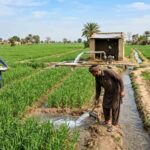
- Canal irrigation (cheaper but uncertain timing)
- Tube-well (available but costly, may be saline)
- Rainfall (unreliable, but important in barani areas)
Practical tip: If tube-well water is salty, mix with canal water when possible. Also check water EC if your crop is sensitive (vegetables, orchards).
Best irrigation practices (easy and proven)
1) Laser land leveling (highly recommended)
- Gives uniform water spread
- Saves water
- Improves fertilizer efficiency
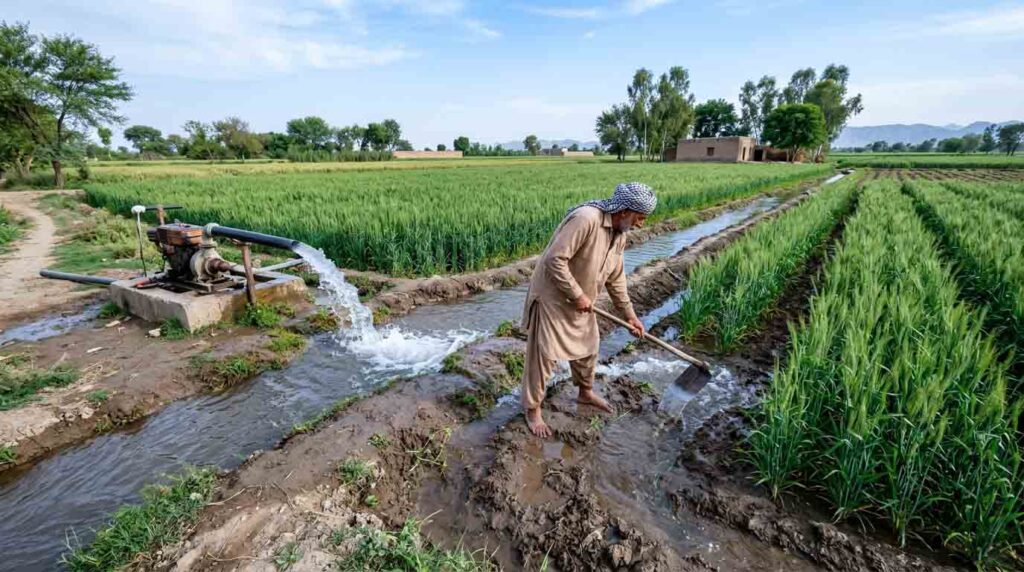
2) Irrigate at critical crop stages (don’t miss these)
- Wheat: crown root initiation, booting, grain filling
- Rice: transplanting establishment, tillering, panicle initiation
- Cotton: flowering, boll formation
- Maize: knee-high, tasseling/silking, grain filling
- Sugarcane: early growth and tillering stages
Missing irrigation at these stages reduces yield more than skipping at other times.
3) Reduce water loss
- Irrigate early morning or late evening (less evaporation)
- Use mulch in vegetables (plastic mulch or crop residue)
- Repair field channels and stop leakage
- Avoid over-irrigation (it washes nutrients below roots)
4) Modern irrigation options (2026 trend)
If you grow vegetables, orchards, or tunnel farming crops:
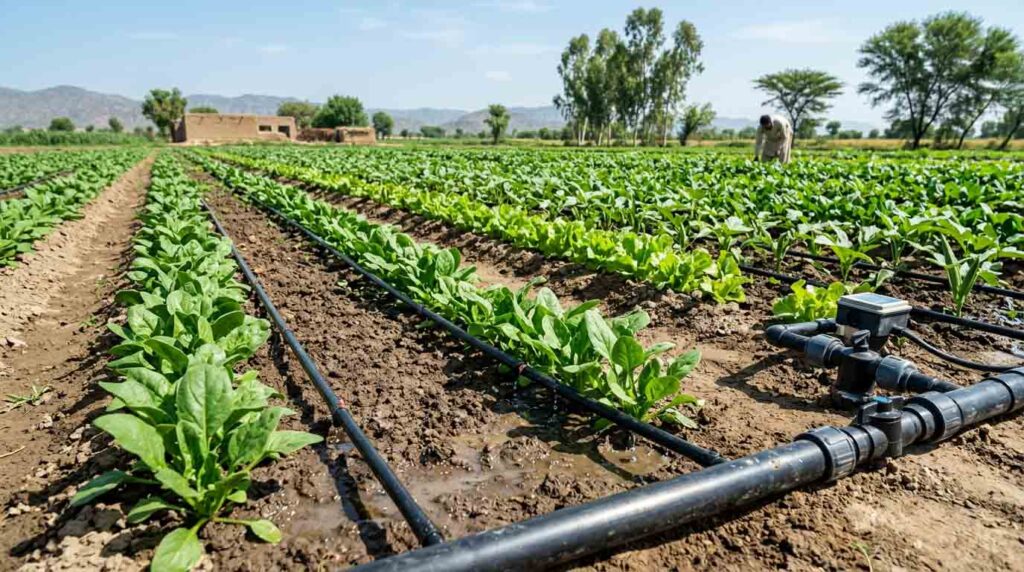
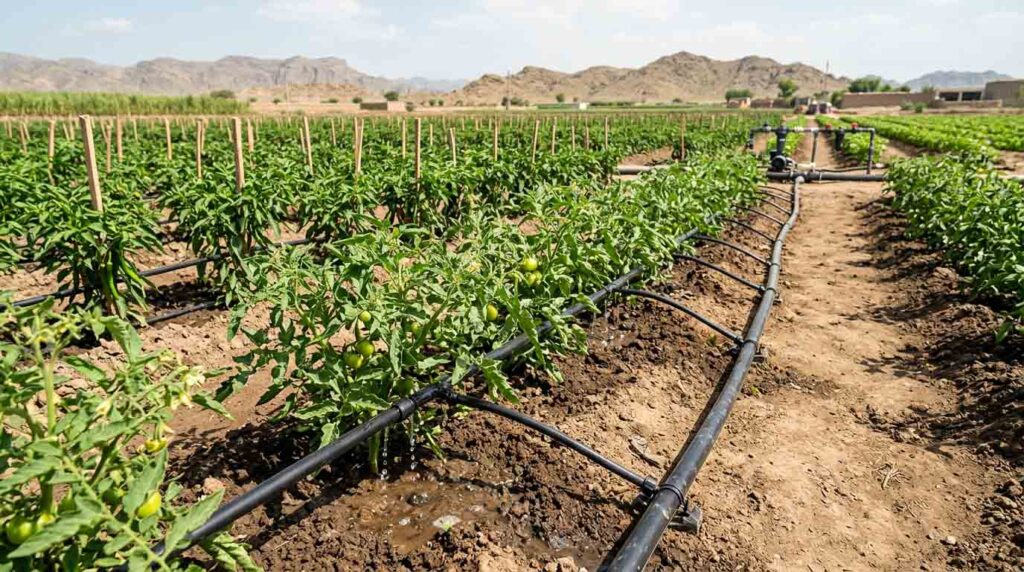
- Drip irrigation saves water and increases fertilizer use efficiency
- Fertigation (fertilizer through drip) gives better results with less waste
Fertilizer Management 2026 (Pakistan) – Step-by-Step Plan
Pakistani farmers commonly use:
- Urea (Nitrogen)
- DAP (Phosphorus + some Nitrogen)
- NPK (balanced fertilizer, different ratios like 15-15-15, 20-20-0, etc.)
The main goal is: Right fertilizer + Right dose + Right time + Right method + Right water.
Step 1 — Start with soil test + crop target
- Decide your target yield (example: wheat 40–50 maunds/acre or more).
- Use soil test report to adjust N, P, K needs.
- If you cannot test every field, test at least once per year and apply lessons to similar fields.
Step 2 — Prepare the field (don’t skip this)
Before fertilizer:
- Add farmyard manure (FYM) or compost if available (improves soil organic matter)
- Level the field for even irrigation
- Ensure proper moisture at sowing time
Practical tip: Even 1–2 trolley FYM per acre (where available) improves soil structure and reduces fertilizer loss.
Step 3 — Basal dose at sowing (foundation feeding)
Basal means fertilizer applied at sowing or transplanting.
Common basal fertilizers in Pakistan:
- DAP: Best for early root growth and strong crop start
- NPK: Good where soil is weak in multiple nutrients
- Sometimes SOP/MOP (potash) if soil is low in potassium (especially for sugarcane, potatoes, banana, some vegetables)
How to apply basal fertilizer correctly
- Place fertilizer near seed zone but not touching seed (to avoid burn)
- Use drill/seed-cum-fertilizer machine if possible
- In rice transplanting, apply basal before puddling or just before transplanting (as per local practice)
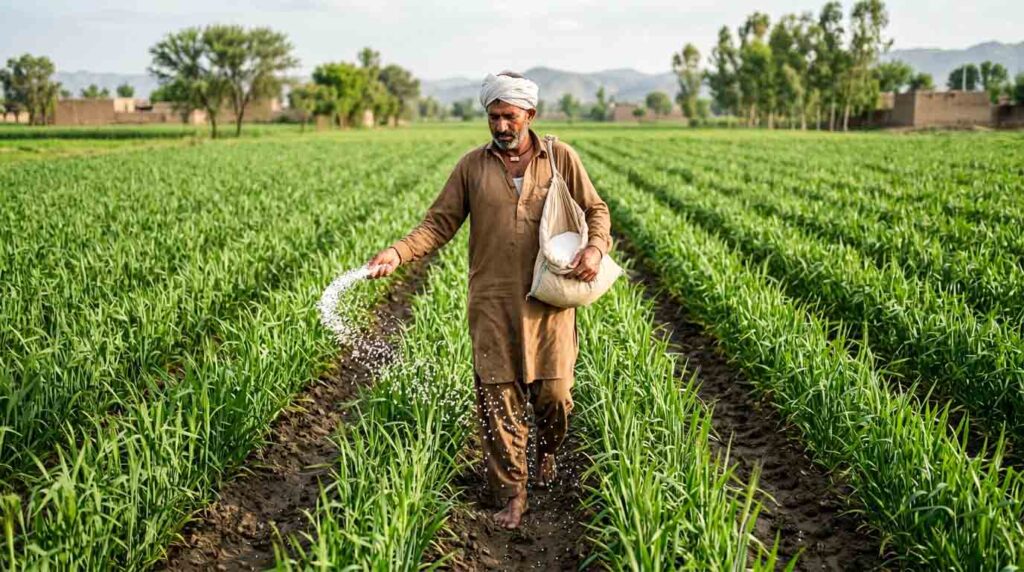
Step 4 — Split Urea application (most important step)
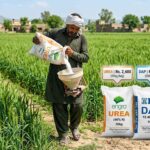
Urea is the most used fertilizer in Pakistan, but also the most wasted if mismanaged.
Best practice: apply Urea in 2–3 splits
- First split: early growth (after emergence / after first irrigation)
- Second split: tillering/branching stage
- Third split (if needed): before flowering or at critical growth stage
Golden rule:
Apply urea when soil has moisture and give light irrigation soon after (or before irrigation). This reduces nitrogen loss to air.
Avoid:
- Applying urea on dry soil and leaving it without irrigation
- Applying before heavy rain forecast (nutrients may wash away)
- Overdose (leads to weak plants, more pests, lodging in wheat)
Step 5 — Use NPK smartly (balanced nutrition)
More Articles
- Complete Guide to Soil Testing Methods in Pakistan 2026
- Best Time and Method to Use Fertilizer for High Yield Crops
Many Pakistani soils have issues like:
- Low organic matter
- Phosphorus deficiency
- Potassium deficiency in some areas (not everywhere)
NPK helps when:
- You grow high-value crops (vegetables, orchards)
- Your soil test shows multiple deficiencies
- You want balanced growth (not just leafy growth)
Practical tip: If crop is very green but weak and disease-prone, it may be too much nitrogen and too little potassium/micronutrients.
Step 6 — Don’t ignore micronutrients (common in Pakistan)
Common micronutrient deficiencies:
- Zinc (Zn): common in rice and wheat
- Boron (B): affects fruit set in many crops
- Iron (Fe): in alkaline soils, especially orchards/vegetables
Use micronutrients only when:
- Soil/leaf test suggests deficiency, or
- Clear symptoms appear and expert confirms
Step 7 — Match fertilizer with irrigation (water + fertilizer together)
Fertilizer efficiency depends on water.
- Too little water → fertilizer stays unused, crop remains weak
- Too much water → fertilizer leaches below roots, money wasted
Best method:
Irrigate properly and apply fertilizers at the right moisture stage.
Practical Tips for Farmers (Quick Checklist)
- Keep simple records: date of irrigation, fertilizer dose, crop stage.
- Use laser leveling if possible (big water saving).
- Prefer split urea rather than one heavy dose.
- In saline areas, avoid over-irrigation and check EC of water and soil.
- Clean water channels and stop leakage (small fixes save big water).
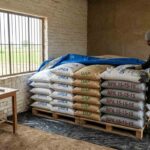
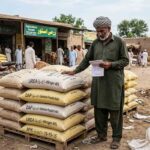
- Store fertilizers in a dry place; keep urea away from moisture.
- If using drip, learn fertigation schedule (small dose, more times).
Common Mistakes to Avoid
- Applying DAP late (phosphorus is most useful early).
- Broadcasting urea and not irrigating (high nitrogen loss).
- Using only urea season after season (imbalanced nutrition).
- Over-irrigation thinking it increases yield (it often reduces yield).
- Ignoring soil salinity signs (white crust, poor germination).
Conclusion
In 2026, Pakistani farmers can improve profits by focusing on efficient water use and smart fertilizer planning. Start with soil testing, apply DAP/NPK as basal, use split urea, and match irrigation with crop stages. Simple steps like laser leveling, correct timing, and balanced nutrients can increase yield and reduce unnecessary cost. Manage your soil like a long-term asset—healthy soil means stable production for many years.
FAQ (Water and Fertilizer Management Pakistan)
1) Which fertilizer is best in Pakistan: Urea, DAP, or NPK?
All are useful, but for different needs. DAP is best at sowing for root growth, Urea is best for crop growth (nitrogen) in splits, and NPK is best when you need balanced nutrients or your soil is weak in more than one nutrient.
2) When should I apply urea for best results?
Apply urea in 2–3 splits, always when soil has moisture. Best timing is usually after irrigation or before a planned irrigation so nitrogen moves into the root zone and does not evaporate.
3) How can I save irrigation water on my farm?
Use laser land leveling, irrigate at critical crop stages, repair channels, and irrigate in early morning/evening. For vegetables and orchards, drip irrigation saves the most water.
4) Is soil testing really necessary every season?
It is highly recommended at least once a year or before major crops. Soil testing saves fertilizer cost and prevents long-term soil damage.
5) What should I do if my tube-well water is saline?
Test water EC, mix tube-well with canal water if possible, avoid over-irrigation, and consider salt-tolerant crops in highly affected fields. Adding organic matter also helps reduce salinity stress.