Tomato Fertilizer Guide for Better Yield in Pakistan is one of the most important vegetable crops in Pakistan. Farmers grow it for local markets, wholesale supply, and home use. A healthy tomato crop can give very good profit, but only when the plant gets the right nutrition at the right time.
Many farmers use fertilizer, but they do not always use the correct type, dose, or timing. Because of this, plants become weak, fruit size stays small, and disease attack increases. Good fertilizer management can improve plant growth, flowering, fruit setting, fruit size, and total yield.
In this guide, we will explain tomato fertilizer use in very simple English. We will discuss important fertilizer types like Urea, DAP, and NPK, practical tips for farmers, and a useful fertilizer schedule. Since many farmers also search for wheat fertilizer Pakistan, we will also include a proper fertilizer schedule for wheat in Pakistan.
If you want better crop results and more income, this guide will help you.
Why Fertilizer Is Important for Tomato Crop
Tomato plants need balanced nutrition from the start of growth until fruit harvest. If the soil does not have enough nutrients, the crop cannot perform well.
Fertilizer helps tomato plants in many ways:
- Strong root development
- Healthy green leaves
- Better flowering
- More fruit setting
- Bigger and better quality tomatoes
- Higher resistance against stress
Tomato is a heavy feeder crop. This means it takes a lot of nutrients from the soil. If farmers do not return nutrients to the land through fertilizer and organic matter, the soil becomes weak over time.
Main Nutrients Needed by Tomato Plants
Tomato plants need three major nutrients in larger quantity:
Nitrogen (N)
Nitrogen helps in:
- Leaf growth
- Green color
- Plant vigor
If nitrogen is low, plants become pale and weak. But too much nitrogen can cause too many leaves and fewer fruits.
Phosphorus (P)
Phosphorus is very important for:
- Root growth
- Early plant establishment
- Flowering
- Fruit setting
Potassium (K)
Potassium helps with:
- Fruit size
- Fruit color
- Disease resistance
- Better quality and shelf life
Tomatoes also need calcium, magnesium, sulfur, zinc, boron, and other micronutrients, but NPK is the main base of fertilizer planning.
Best Fertilizer Types for Tomato in Pakistan
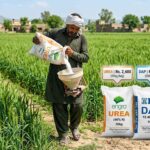
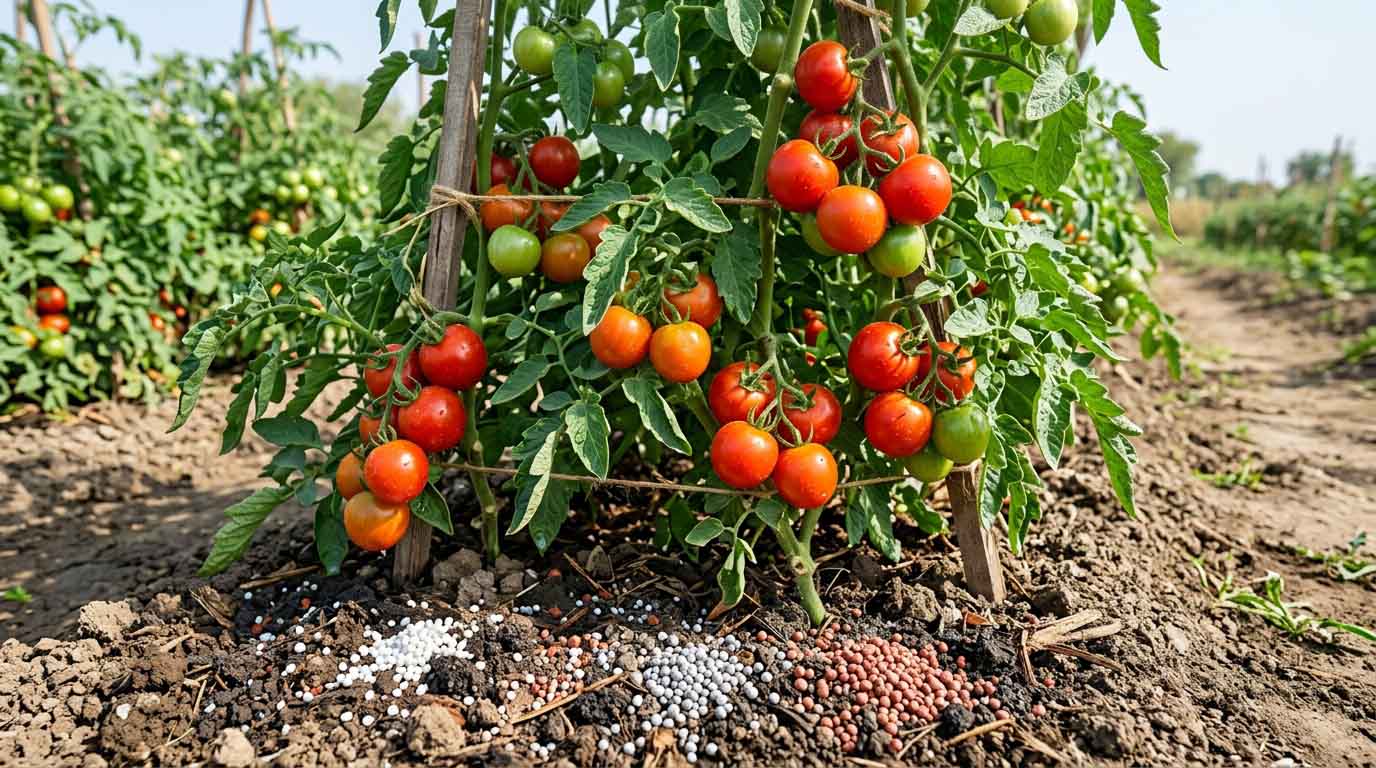
The most common fertilizers used by farmers in Pakistan are:
Urea
Urea contains nitrogen. It is widely used because it is easily available and gives quick response.
Benefits of Urea in tomato crop:
- Boosts vegetative growth
- Improves green leaf development
- Helps plants recover after transplanting
Important tip:
Do not apply too much urea at one time. Too much nitrogen can cause:
- Excess leaf growth
- Delayed flowering
- Soft plants
- More pest and disease risk
More Related Articles
- Select Cotton Crop Fertilizer Guide in Pakistan 2026
- Fertilizer Application Schedule for Different Vegetables and Wheat in Pakistan
- Recommended Fertilizer Quantity per Acre for Maize in Pakistan
DAP
DAP stands for di-ammonium phosphate. It provides nitrogen and phosphorus.
Benefits of DAP:
- Improves root development
- Helps early plant growth
- Supports better flowering
- Useful at land preparation or transplanting stage
DAP is best when mixed into soil before transplanting.
NPK
NPK fertilizers contain nitrogen, phosphorus, and potassium in different ratios. Different formulas are available, such as:
- 15-15-15
- 20-20-20
- 10-10-30
- 12-12-17+2MgO
Benefits of NPK:
- Balanced crop feeding
- Better fruit formation
- Improved crop quality
- Easy nutrient management
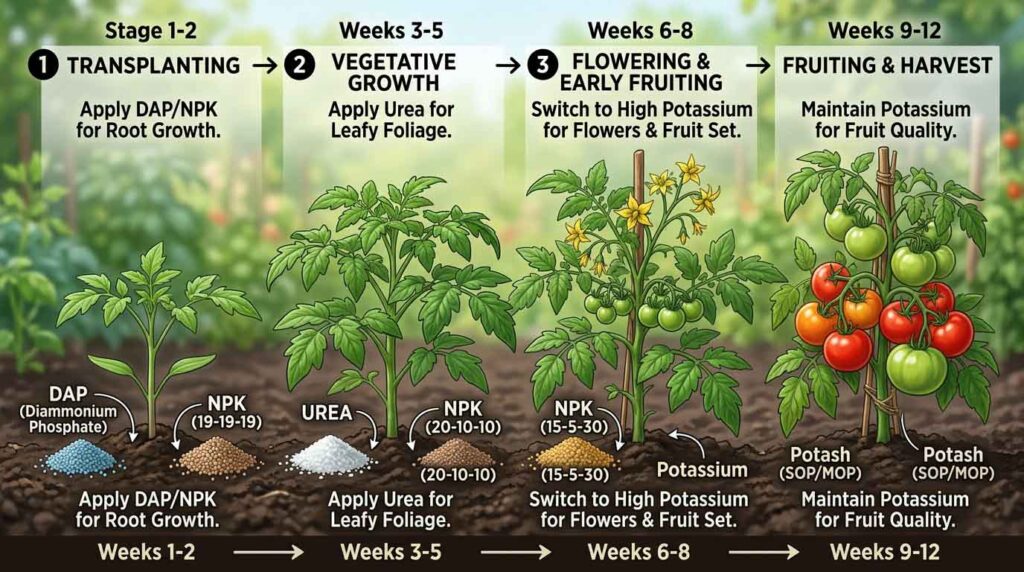
For tomato, balanced NPK is helpful in early stages, while higher potassium formulas are useful during flowering and fruiting.
Tomato Fertilizer Schedule in Pakistan
A proper fertilizer schedule is very important for getting high tomato yield. The exact dose depends on:
- Soil fertility
- Variety
- Season
- Irrigation system
- Hybrid or local seed
It is always best to do a soil test. But if no soil test is available, farmers can follow a general schedule.
General Fertilizer Recommendation Per Acre for Tomato
A common general recommendation can be:
- DAP: 2 to 3 bags per acre
- Urea: 2 to 2.5 bags per acre
- SOP or Potash source: 1 to 1.5 bags per acre
- Well-rotted FYM: 8 to 10 tons per acre
Stage-Wise Tomato Fertilizer Schedule
1. Before Transplanting
At land preparation stage, apply:
- Full farmyard manure
- Full DAP
- Half potash
- One-third urea
Mix these well into the soil before transplanting.
2. 15 to 20 Days After Transplanting
Apply:
- One-third urea
This helps plants grow strong after establishment.
3. At Flowering Stage
Apply:
- Remaining one-third urea
- Remaining half potash
- If available, use balanced NPK
This stage is very sensitive. Good nutrition at flowering means more fruit setting.
4. During Fruit Development
If crop looks weak, use:
- Water-soluble NPK
- Foliar spray of micronutrients
- Calcium and boron if needed
This improves fruit size and quality.
Practical Tips for Tomato Fertilizer Use
Farmers often ask which fertilizer is best, but the real answer is balance and timing. Here are some practical field tips:
1. Use Organic Matter
Before planting tomato, add well-rotted farmyard manure. It improves:
- Soil structure
- Water holding
- Root growth
- Fertilizer efficiency
2. Never Apply All Urea at Once
Split urea into 2 or 3 doses. This is better because:
- Nutrient loss becomes less
- Plant gets steady feeding
- Growth remains balanced
3. Irrigate After Fertilizer Application
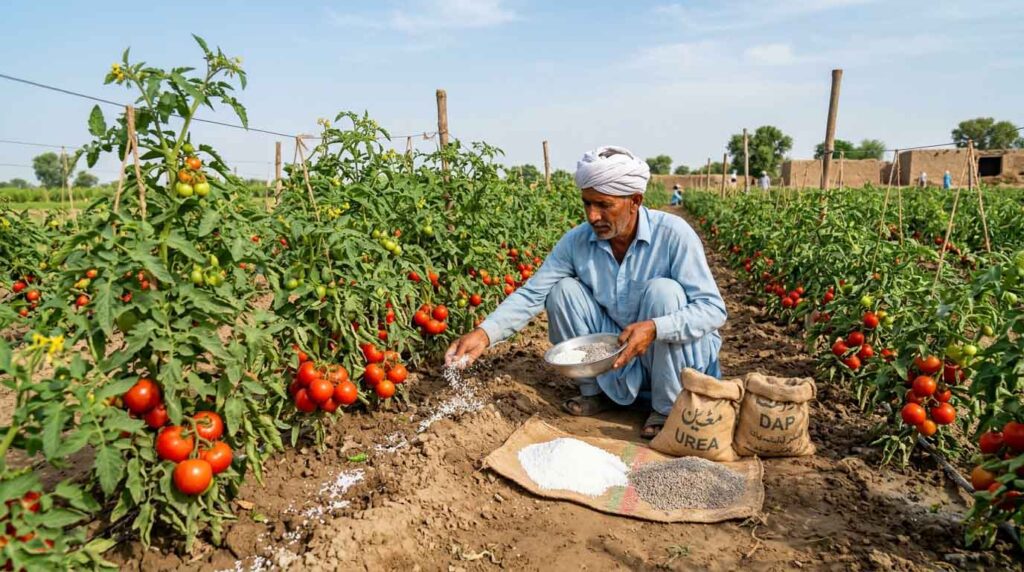
After applying fertilizer, give light irrigation if needed. This helps nutrients move into the root zone.
4. Avoid Fertilizer Touching Plant Stem
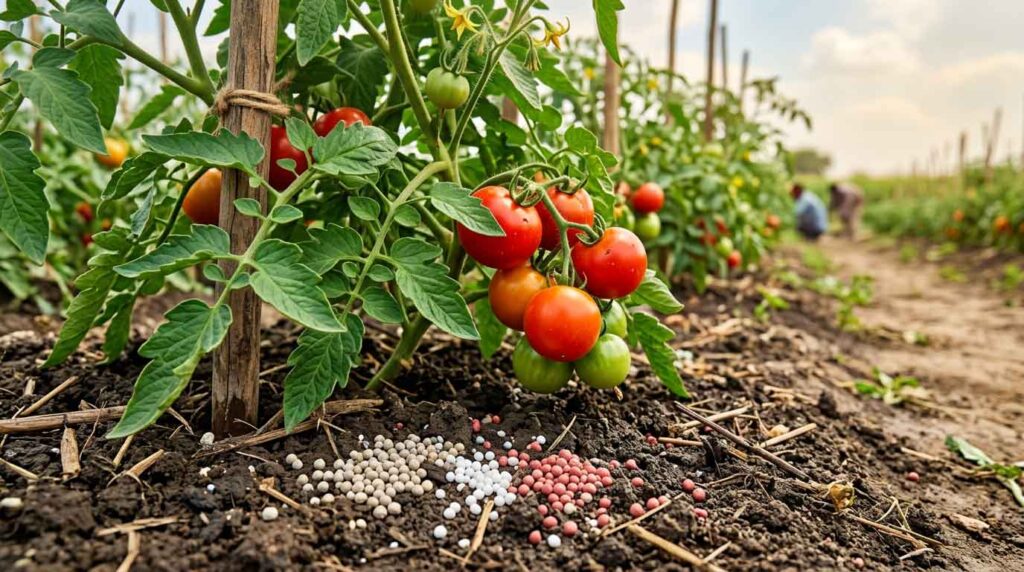
Do not place fertilizer directly on the stem. It can burn young plants. Apply it slightly away from the plant and mix with soil.
5. Watch the Plant Signs
Plants often show nutrient problems:
- Yellow leaves may mean nitrogen deficiency
- Purple tint may show phosphorus deficiency
- Poor fruit size may show potassium deficiency
Field observation is very important.
6. Use Potash for Better Fruits
Many farmers focus only on urea and ignore potash. This is a mistake. Potassium is very important for:
- Fruit weight
- Color
- Quality
- Market value
7. Foliar Spray Can Help in Stress
If weather is too hot, too cold, or plants are under stress, foliar spray of micronutrients or water-soluble NPK can give quick support.
8. Do Soil Testing If Possible
A soil test saves money and improves fertilizer planning. It tells you what your land actually needs.
Common Fertilizer Mistakes in Tomato Farming
Avoid these common mistakes:
- Too much urea use
- No use of potash
- Applying fertilizer in dry soil
- No organic matter in the field
- Applying all fertilizer in one dose
- Ignoring micronutrient deficiency
- No soil test for many years
These mistakes can reduce yield and waste money.
Conclusion
Tomato farming can be very profitable in Pakistan if farmers manage fertilizer properly. The crop needs a balanced supply of Urea, DAP, and NPK for healthy growth, flowering, and fruit development. Organic manure, split fertilizer doses, and proper irrigation after application all help improve results.
Farmers should also avoid overuse of urea and should not ignore potash. If possible, get a soil test before finalizing the fertilizer plan.
Also, for farmers interested in wheat fertilizer Pakistan, a proper wheat fertilizer schedule has been shared above. Balanced use of DAP and urea at the right stage can improve wheat growth and grain yield.
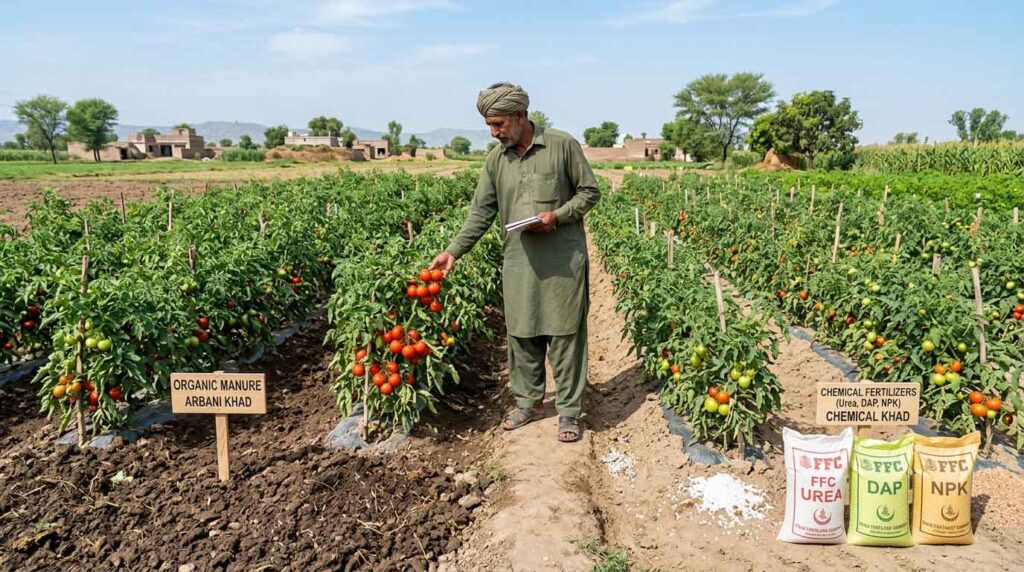
Good fertilizer management is not just about using more bags. It is about using the right fertilizer at the right time. That is the real key to better production and better profit.
FAQs
1. Which fertilizer is best for tomato in Pakistan?
There is no single best fertilizer. Tomato crop usually responds well to a balanced program using DAP, Urea, and NPK, along with potash and organic manure.
2. Can I use only urea for tomato crop?
No, using only urea is not a good practice. Urea gives nitrogen, but tomato also needs phosphorus and potassium for roots, flowering, and fruit quality.
3. When should I apply DAP in tomato?
DAP should mostly be applied at land preparation or before transplanting. It helps root growth and early plant establishment.
4. What is the general wheat fertilizer Pakistan recommendation per acre?
A common general recommendation is 1 to 1.5 bags DAP and 2 to 2.5 bags urea per acre, depending on soil and water conditions.
5. Why is potash important in tomato crop?
Potash improves fruit size, color, quality, and disease resistance. It also helps tomatoes stay firm and marketable.